Categories
Living New York City Serendipity

The Grammar of Looking Up

The apartment was across from Penn Station, which meant that for one stretch of months in the mid-1970s, the architecture of my days was decided by trains I never took. I walked east instead, every morning, toward the United Nations, where a man named Frank Smith ran a personal development course that IBM SRI had decided its young people should sit through. I don’t remember most of what Frank said in that room. I remember one thing he said about the street outside it.

He told us we should start looking up. Literally โ€” on our walks back and forth across midtown, Penn Station to the East Side and back, twice a day, rain or not. Not all the way, usually. Mostly it was a floor or three: the window line just above the awnings, the cornice on a building you’d never once registered had a second story, let alone a sixth. The full climb to the rooflines โ€” gargoyles, setbacks, terra cotta lions โ€” was the occasional reward. Almost no one looks up in New York, he said, not even a little. The city trains you out of it. Too much at eye level demands your attention โ€” the cabs, the steam, the man asking for change, the woman walking too slowly in front of you โ€” so everything above your own eyeline disappears by consensus, not just the tops. Habits can be replaced. Look up enough times, even just a floor or three, and you’ll see a different city than the one everyone else is seeing.

I tried it. Walking up past the Pierpont Morgan stretch, or wherever the route took me, chin lifted some small number of degrees, feeling slightly foolish. Most days that was the whole of it โ€” a window line, a row of air conditioners, a sign painted directly onto brick decades before anyone called that vintage. Every so often the chin would tip back further, and there’d be something up there worth the extra degrees. A gargoyle with its mouth open mid-roar, forty years before air conditioning made gargoyles decorative rather than necessary. But that was the rare find. The habit was the floor or three. Nobody else on the sidewalk was seeing any of it, because nobody else on the sidewalk was looking at all.

The chin came back down on its own a couple of times a week, somewhere around a street corner with a slice joint on it, because New York seems to put one on every corner whether you need it or not. You smelled it before you saw it โ€” that specific combination of tomato, oregano, and hot grease that has no name I’ve ever found. Looking up was Frank’s discipline.

The pizza smell required none. It just reached out and took your head by the chin and turned it level again, toward the window with the steam on the glass and the guy folding a slice in half before he handed it over.

It is a small thing Frank Smith said in a room near the UN fifty years ago, and I have carried it around since the way you carry around a key to a house you no longer own. I don’t know what happened to the course, or to IBM SRI’s faith in such courses, or to Frank himself. I know what happened to the habit. It outlived the year, outlived the apartment across from Penn Station, outlived several cities I’ve lived in since that didn’t have the same vertical drama to reward the looking. I still do it. I did it last week on a walk that had nothing to do with midtown at all, tilting my head back on a street in California to find whatever was up there worth finding, and catching myself mid-gesture, thinking: that’s Frank’s, that one, still running fifty years later on the program he installed.

Most of what we’re taught to notice, we’re taught by people who wanted something from us โ€” a sale, a vote, a grade. Frank wanted nothing, as far as I could tell, except that we see more of the city than we’d been seeing. It’s such a small ambition for a teacher to have. Look up. That’s the whole curriculum. And it’s the only thing from that course, the only thing from that whole strange year of being instructed in personal development by a man whose face I can no longer quite reconstruct, that I still do, unbidden, on every street I’ve walked since.

Categories
Monochrome Photography New York City Photography Photography - Black & White

Bookends

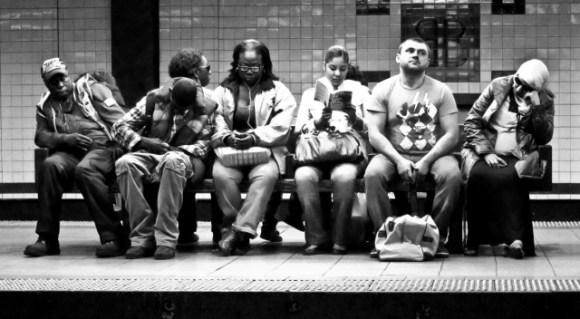
The tile is the first thing, and it should be. Count the squares if you want โ€” institutional cream, grouted in a pattern nobody alive remembers choosing, the kind of tile that has been absorbing the heat and noise of trains since before anyone on this bench was born. This line has been running since 1904. The platform across from it, the old City Hall stop, closed in 1945 and now exists only as a rumor riders pass through without seeing, a loop the express makes for no reason except that turning around takes track. Everything in this photograph is standing on top of something that used to be a destination and is now just a curve in the dark.

Seven people are sitting on a bench that has nothing to do with any of that history, and everything to do with it.

Start with the one who’s still here. T-shirt, checkerboard skull, gym bag held against his ankle the way you hold something you can’t afford to lose track of. His hands are clasped between his knees, not relaxed, not nervous โ€” occupied. Everyone else on this bench has gone somewhere else. He hasn’t. He’s looking off toward the tunnel mouth with the specific stillness of a man doing arithmetic about how late he already is, and the bag at his feet is doing exactly what gym bags do at that hour, which is stand in for whatever he’s actually carrying.

To his left, a woman reads a paperback โ€” Wilde, from the spine, which is its own small joke on a subway platform, a story about a man who doesn’t age sitting in the lap of a woman waiting on a train that’s already late. Her purse, gold, sits on her knees like a paperweight holding her place. Next to her, a woman in a cream jacket has wired herself into something private through a pair of earbuds, hands folded over a small plaid pouch she’s guarding like it’s worth more than its size suggests. Two men at the far end have given up on consciousness altogether โ€” one with his chin dropped into the posture every commuter eventually perfects, the other with his head against a fist and a phone somewhere near his ear, gone in whatever direction that call is taking him.

This is what a downtown platform in lower Manhattan does to seven strangers at whatever hour this was: financial district behind them, City Hall and the courthouses above, the bridge somewhere overhead carrying its own century of foot traffic โ€” and none of it matters to the bench. The bench doesn’t know what borough it’s in. It just holds people until the train comes and takes the holding away.

The photograph is called Bookends, for the two men slumped at either end, and that’s the obvious read. But look again at who’s in the middle โ€” the reader with her book, held between two men who have shut the world off completely. She’s the only one inside a story while sitting inside someone else’s. That’s the trick of the title. It sounds like geometry. It’s actually about who, on a bench like this, is still willing to be somewhere other than gone.

The train would come. It always does, eventually, on a line that’s been doing this since 1904, two minutes or eight minutes late, and it would take all seven of them in whatever direction they were waiting for, and none of them would know they’d spent four minutes on a bench old enough to have held this exact scene ten thousand times before โ€” six people who’d left, and one who, for reasons of his own, hadn’t gone anywhere yet.

Categories
AI New York City San Francisco/California Work

The Paradox of the Pulse

The skyline has always been a silhouette of our collective ambition. For a century, the steel and glass towers of our major cities functioned as the secular cathedrals of the modern age. But as Andrew Yang observes in his reflection on the shifting urban landscape, the pews are emptying. The “doom loop”โ€”a self-reinforcing cycle of vacant offices, declining tax revenue, and diminishing servicesโ€”is a mathematical ghost haunting our city planners.

Yet, if you walk the streets of Manhattan today, the sidewalks are often busier than ever. In San Francisco, the “Cerebral Valley” AI boom is sparking a gold rush of intellect that rivals the original tech explosion. We are witnessing a strange paradox: the Death of the Office occurring simultaneously with a Rebirth of the Urban Pulse.

The crisis Yang describes is real, but it may be a crisis of form rather than function. We tolerated the friction of urban life for the sake of career “flow.” Now that the flow is digital, the city is being forced to justify its existence through something more primal: energy.

“We are looking at a fundamental restructuring of the American city. The office was the sun around which everything else revolved. Now, that sun is dimming.”

The AI boom isn’t happening over Zoom; itโ€™s happening in “hacker houses” and shared spaces where the speed of a conversation over coffee outpaces a fiber-optic connection. This suggests that the “doom loop” might only apply to the traditional, sterile corporate cubicle. The city is shedding its skin. It is moving away from being a place where we must be, toward a place where we want to be.

Yangโ€™s warning serves as a necessary guardrail. We cannot ignore the fiscal cliff of empty high-rises. However, the vibrancy of NYC and the reinvigoration of SF suggest that the city isn’t dyingโ€”it’s just no longer a captive audience. We are standing in the ruins of an old habit, watching a new, more intentional way of living together take root in the cracks.


Five Questions to Ponder

  • The Pull of Proximity: If we no longer have to be in the city for a paycheck, what is the specific “energy” that keeps you coming back to the sidewalk?
  • The AI Renaissance: Is the AI boom in SF proof that high-innovation industries require physical density, or is it just the last gasp of the old model?
  • Form vs. Function: If a skyscraper can no longer be an office, what is the most radical thing it could become to serve a “busy” city?
  • The Captive Audience: For decades, cities were built for people who had to be there. How does a city change when it has to “woo” its citizens every single day?
  • Digital Nomads vs. Urban Anchors: Are we moving toward a world of “temporary density,” where cities are vibrant hubs for projects but no longer long-term homes?
Categories
Lightroom Photography Photography - Canon PowerShot S90 Photoshop CC

Bookends – The Color Version

Bookends #2 - New York City - 2010

I’ve got two photos of mine hanging in my home office. One is a wide image shot at Sparks Lake near Bend, Oregon this summer. The other is a monochrome version of this “Bookends” image. Both are Sizzlpix images – and they’re magnificent. No frames, they just stand out from the wall as if they’re floating there. Beautiful.

I’ve been wanting to go back to “Bookends” for a while – to try a color version. The monochrome is very powerful – but there are some beautiful colors in the original shot taken with my Canon PowerShop S90 (since sold!).

This version was re-edited in Lightroom 5 and Photoshop CC. A subtle use of Topaz Simplify 4 was applied before using the Camera Raw filter to make some final tweaks. A bit of sharpening and a vignette applied back in Lightroom finished it off.

Brings back such great memories of our visit to New York!…

Categories
Fujifilm X-E2 Photography Photography - Fujifilm X-E2 Street Photography

Happy Thanksgiving!

On the Move - New York City - 2013

Best wishes for a wonderful Thanksgiving!

This image is from a visit to New York last week – walking up Madison Avenue heading to an early dinner. Shot with my Fujifilm X-E2 while on the move.

Categories
iPhone 5s Photography

Oh MoMA!

MoMA - New York City - 2013

While we were in New York City last week, we headed to dinner at The Modern – a great restaurant adjacent to the Museum of Modern Art. We got there a bit early – and spent some time looking around the MoMA Store which is open a bit later than the museum itself.

I’m not much of a shopper – so I headed outside with my cameras – and pulled out my iPhone 5s to make this shot from across the street.

In photography, it helps to be lucky – and this shot demonstrates that – with the two guys heading into each other at the lighted tree. I had my iPhone 5s camera in HDR mode – this was the first shot the camera took. The second – HDR – shot had them in line together with the tree and was much less interesting! My photo buddy Doug Kaye commented how his eye was immediately drawn to those two guys. Great fun!

Categories
Fujifilm X-E2 Photography Photography - Fujifilm X-E2

A Special Sunrise along New York’s Central Park West

Central Park West - New York City - 2013

Here’s an image overlooking Central Park shot early in the morning last week with my Fujifilm X-E2.

The glow of the sun along the buildings was perfect – and the late fall muted colors in the trees added a nice touch of contrast.

Categories
iPhone 5s Photography

Leading Lines in Gotham!

Leading Lines in Gotham!

I was on my way to meet with Superman last weekend – just kidding! – here’s a shot taken with my iPhone 5s of Rockefeller Center in New York City. The Christmas tree was still under wraps but otherwise everything was quite holiday festive.

Post-processed in the iPhone 5s using the Painteresque and Perfectly Clear applications.

Categories
Living Photography Photography - Canon PowerShot S90

Bookends

Many have commented privately to me about the photo above – which I have titled “Bookends”. Here’s the story…

Bookends

Sometimes I come across a scene that’s just right. But, that’s a rare event. Most other times, there’s just noise in my eyes – and I’m frustrated about shooting.

You know that feeling. You look and look – but don’t see anything. Nothing. Nothing interesting. Nothing compelling. Just noise. More noise.

Why do we do this to ourselves? In spite of it, we pack our camera and head out – looking for that decisive moment, even as it continues to elude us. Camera at the ready, we continue scanning for the right opportunity.

Our eyes are amazing sensors. We humans are so gifted. As we scan, back and forth, we begin to get inside the frame. If we’re lucky, we start to have “camera eyes” – seeing in that special new way. When the light is just right, we see whole new scenes. And, if we slow down – so important – we begin to see so much more.

Last April, I came across one of those frames – tucked away in the heart of the Brooklyn Bridge subway station in New York City. After a long day of walking and exploring, we walked down the stairway into the underground canyon of the station. We were dog tired – looking forward to an express train ride up the backbone of New York to get home.

As we sat down to wait for our train, I looked across to the other platform and saw an amazing scene. Quickly grasping my camera, I struggled to fire off one quick shot – as that one guy was looking right at me.

Turns out he looked away – up and away just as the shutter snapped. Perfect.

When I finally got a good look at the image, a title immediately came to mind: Bookends. Like an overstuff bookshelf, the two folks on each end of the image each flared out away from the rest. Bookends. A wonderful memory of a springtime street scene underground in New York City.