Categories
Aging Living Paris Serendipity Street Photography

The Geometry of Choices: Life Beyond the Viewfinder

Every day, I walk past Henri Cartier-Bresson’s The Decisive Moment resting quietly on my bookshelf. Its spine is a familiar friend, a silent anchor in the room.

For Cartier-Bresson, the decisive moment was a photographic philosophy: the simultaneous recognition of the significance of an event, paired with the precise organization of forms that gives that event its proper expression. It is the fraction of a second where the head, the eye, and the heart perfectly align.

“To me, photography is the simultaneous recognition, in a fraction of a second, of the significance of an event as well as of a precise organization of forms which give that event its proper expression.” — Henri Cartier-Bresson

But as I caught sight of the book this morning, I realized how deeply this concept bleeds beyond the edges of a viewfinder. We tend to measure our lives in chapters and milestones—graduations, marriages, career shifts, relocations. We look at these grand events as the towering pillars of our personal history. Yet, if we look closer, the actual architecture of our lives is built on a series of fleeting, decisive moments.

Think about it. The true turning points rarely announce themselves with a booming voice or a dramatic swell of music. They are profoundly quiet.

It’s the split-second decision to take a different route home where you stumble upon a neighborhood you’ll eventually live in. It’s the pause before answering a question that completely changes the dynamic of a relationship. It’s the instant you decide to say “yes” to an unexpected invitation, opening a door to a career you hadn’t even imagined.

In these moments, just as in photography, there is a sudden geometry to our choices. The elements of our past experiences, our current desires, and our future trajectories suddenly arrange themselves into a perfect composition. We may not hear the click of a shutter, but the picture of our life is forever altered.

I run my finger over the dust jacket sometimes and think about the paths I didn’t take. The moments I hesitated just a second too long, and the composition dissolved into chaos. There is grace in those missed moments too, of course—they teach us how to hold our gaze steady for the next time.

The tragedy is that we often miss these fractions of a second entirely. We move too fast. We are too distracted by the noise of the future or the echoes of the past to recognize the composition forming right in front of us. We forget to keep our eyes open.

Cartier-Bresson roamed the streets of Paris with his Leica, intensely present, waiting for life to unfold. How often do we roam the streets of our own lives with that same level of presence?

To capture the decisive moments of our lives, we don’t need a camera. We need awareness. We need to cultivate a stillness that allows us to recognize when the head, the eye, and the heart are asking us to act.

It’s about trusting our intuition when the geometry feels right, even if we don’t fully understand the picture yet.

The next time you find yourself hesitating—caught in a quiet fraction of a second—pay attention. It might not be a milestone. It might just be an ordinary Tuesday. But it might also be the exact moment the elements of your life perfectly align.

Click.

Categories
History Living Telephones

The Coiled Tether

Do you remember the physical weight of a conversation? It lived in the coiled, plastic spring of a landline telephone cord. We would stretch it across the kitchen, pacing over linoleum floors, the coil twisting around our fingers as we talked into the evening.

That cord was a literal tether. It confined us to a specific radius, but in doing so, it anchored us to the present moment. When you were on the phone, you were nowhere else. You were anchored to the wall, and by extension, to the person on the other end of the line.

There was also the sheer tactile satisfaction of the device itself—the heavy, contoured plastic of the receiver that fit perfectly between shoulder and ear, and the definitive, emphatic slam of hanging up on someone, a punctuation mark that the gentle tap of a touchscreen will never quite replicate.

Then came the subtle, sharp click on the line. Call waiting.

“We traded deep, uninterrupted connection for the anxiety of possibility.”

It was our first taste of modern conversational fragmentation.

Before call waiting, a busy signal was a polite “do not disturb” sign hung on the door of an ongoing dialogue. It meant you were occupied, engaged, entirely spoken for.

The click changed everything. It introduced a sudden, silent geometry to our relationships. When that secondary tone sounded, you were forced into a split-second hierarchy: do I stay with the person I am talking to, or do I chase the mystery of the unknown caller? The phrase, “Can you hold for a second?” became a small, culturally accepted betrayal of the present moment.

We traded deep, uninterrupted connection for the anxiety of possibility.

Eventually, the mystery of the ringing phone was solved altogether by a small, rectangular box with a glowing LCD screen: Caller ID.

For decades, a ringing phone was an invitation to a blind date. You picked up the receiver with a mix of anticipation and vulnerability. It could be a best friend, a wrong number, a telemarketer, or the person you’d been hoping would call all week. You answered with a universal greeting—a neutral, expectant “Hello?”—because you had no idea who was stepping into your home through the wire.

Caller ID gave us the power of the gatekeeper. It allowed us to screen, to prepare, to decide if we had the emotional bandwidth for the name flashing in digital text. We gained control, but we lost serendipity. We lost the unfiltered, genuine surprise of hearing a familiar voice when we least expected it. We stopped opening the door blindly and started looking through the peephole.

Today, we are entirely untethered. There are no coiled cords tying us to the kitchen wall. We carry our communication in our pockets, capable of ignoring texts, sending calls to voicemail, and managing our availability with unprecedented precision. Yet, for all this freedom and control, it often feels as though we are more disconnected than ever.

The good old days weren’t necessarily better because the technology was superior; they were beautiful because the limitations of the technology forced us to be human. The cord forced us to stay put. The lack of caller ID forced us to be open. The absence of call waiting forced us to finish the conversation we started.

Sometimes, looking back, I miss the simple, undeniable commitment of answering a ringing phone, twisting the cord around my index finger, and just listening.

Categories
Black and White Monochrome Photography Photography Photography - Black & White Photoshop Photoshop CC San Francisco/California Street Photography

Adding Presence to Black and White Photos

Three years ago I was in Havana participating in a person-to-person cultural exchange organized by the Santa Fe Photographic Workshops. One of the photography group leaders at that session was George DeWolfe. While I wasn’t in his group, we did share breakfast a couple of days and I really enjoyed getting to know him a bit more.

After that meeting, I’ve followed George from a distance – and I particularly enjoy the work he’s been doing for years around the notion of adding “presence” to black and white images. I haven’t been using his techniques, however – but a blog post that I read this morning by Julia Anna Gospodarou brought me back to George and re-learning one of his simple techniques for adding presence to an image in Photoshop.

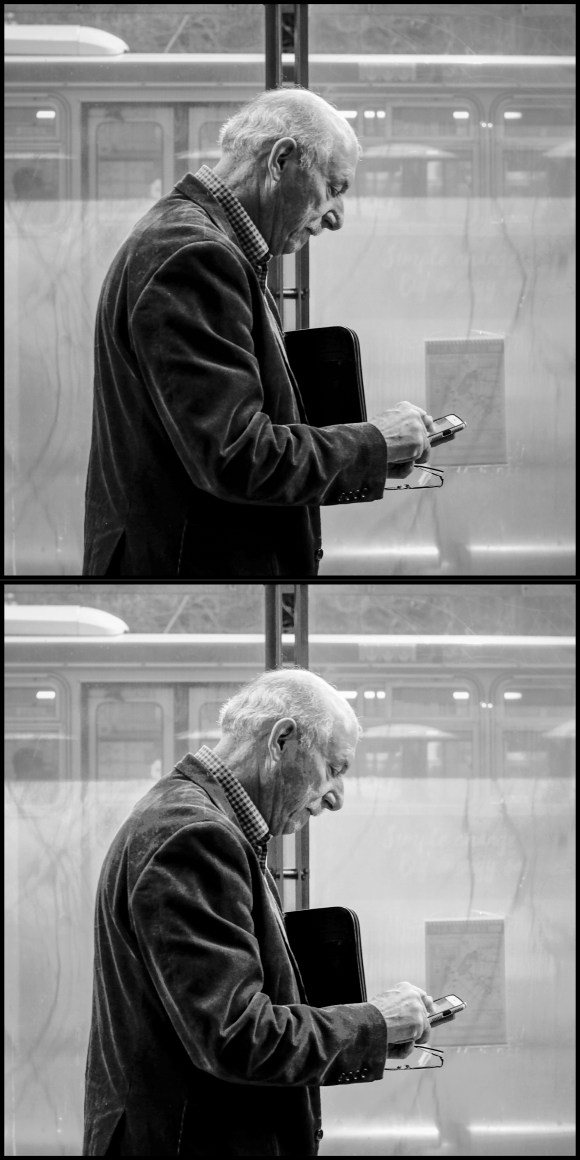
Last night I processed the top image below taken on a photo walk with Doug Kaye in San Francisco last Thursday. We often find the Muni bus stops along San Francisco’s Market Street to be good “stages” – and we await for interesting actors to appear. I was pretty happy with the image last night but when I looked at it again this morning I found it a bit “flat”.

Reading Julia Anna’s interview with George got me motivated to try a quick version of one of his techniques for adding presence – using the Color Range tool in Photoshop to separately adjust the brightness and contract of the highlight, mid-tone, and shadow areas of the image. This is a super easy technique – using the Color Range tool to create a selection of, for example, the highlights in the image – then use a Brightness/Contrast adjustment layer to tweak the brightness and contrast of just the highlights. Do the same thing for the mid-tones and then for the shadows. Takes about 2 minutes to adjust the image this way – and it does help reduce the flatness and spread out the tonality of the image to make it more appealing. The second image below shows the result of my quick adjustments this morning.

There are other ways to accomplish this – with much finer grain control, for example, you can use Tony Kuyper’s Luminosity Mask technique to also do this. But the quickness of using Color Range with a few Brightness/Contrast adjustment layers makes for a very speedy workflow. Thanks to George DeWolfe for sharing this technique – which he first wrote about back in 2007, almost ten years ago.